
High-tech abstract background with flowing data streams in m
Technical Standards

Algorithmic Bias Mitigation Protocols

Systematic methodologies for identifying, measuring, and neutralizing systematic errors in machine learning models to ensure equitable outcomes and regulatory compliance.

Core Concepts & Definitions

What is algorithmic bias in a technical context?

Algorithmic bias refers to systematic and repeatable errors in a computer system that create unfair outcomes, such as privileging one arbitrary group of users over others. In Machine Learning, this often stems from skewed training data or flawed feature selection. Understanding this is critical for any Machine Learning Compliance Framework.
Why is statistical parity essential for compliance?

Statistical parity ensures that the probability of a positive outcome is equal across different demographic groups. Regulatory bodies increasingly use these metrics to determine if a model violates anti-discrimination laws. This aligns directly with the requirements outlined in the NIST AI Risk Management Framework.

Can bias be fully eliminated from ML models?

Technically, total elimination is rarely possible due to the "fairness-accuracy trade-off." However, mitigation protocols aim to reduce bias to levels deemed acceptable by legal and ethical standards through rigorous pre-processing and in-processing techniques.

Strategic Mitigation Benefits

Implementing standardized protocols ensures systemic stability and long-term model reliability.

Regulatory Alignment

Maintain compliance with global AI regulations by documenting every step of the bias mitigation process for future audits.

Risk Reduction

Minimize legal liabilities and reputational damage by proactively scanning for disparate impact before model deployment.

icon-c

Enhanced Data Integrity

Improve overall model performance by identifying and correcting low-quality or non-representative data subsets.

1. Taxonomy of Algorithmic Bias

To effectively mitigate bias, one must first categorize its origin. We distinguish between historical bias, which reflects existing societal prejudices captured in data, and representation bias, occurring when specific populations are underrepresented in the training set. Furthermore, measurement bias arises when the proxies used for labels are flawed, such as using arrest records as a proxy for criminal activity.

Engineers must also consider aggregation bias, where a single model is applied to a diverse population, failing to account for distinct subgroup characteristics. Categorizing these biases allows for the selection of the correct mathematical intervention. Without this taxonomy, mitigation efforts often fail because they target the symptoms rather than the underlying mechanism of the error.

2. Statistical Parity and Fairness Metrics

Measurement is the prerequisite for management. PolicyOps utilizes a suite of quantitative metrics to evaluate model equity:

  • Disparate Impact Ratio: Comparing the selection rate of a protected group vs. a privileged group (the 80% rule).
  • Equalized Odds: Ensuring true positive and false positive rates are consistent across all demographic subsets.
  • Demographic Parity: Requiring the likelihood of a positive outcome to be independent of protected attributes.
  • Counterfactual Fairness: Testing if a model's prediction changes if only the protected attribute is altered.

3. Pre-processing Mitigation Techniques

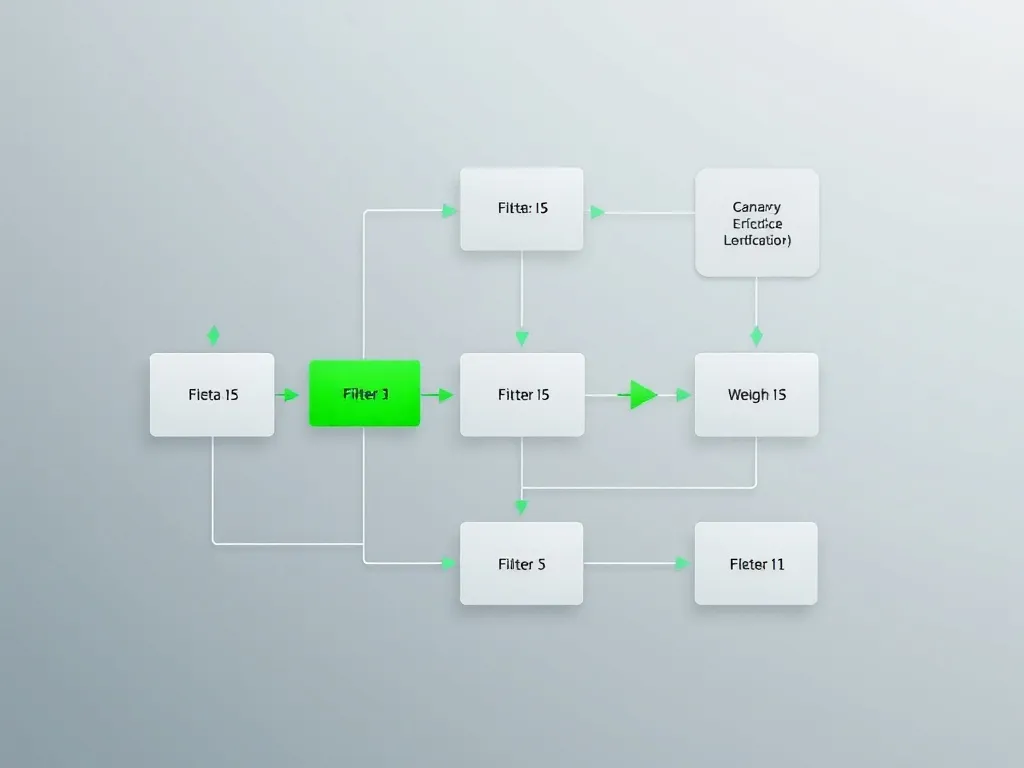
Pre-processing interventions occur before the model training phase. The objective is to transform the data such that the bias is removed while preserving as much information as possible. Techniques include re-weighing, where different weights are assigned to examples in the training set to ensure fairness, and optimized pre-processing, which learns a probabilistic transformation of the data.

Technical diagram showing data flowing through filters and w
Illustration 1 — A standardized data re-weighting pipeline for bias neutralization.

It is important to understand that pre-processing is often the most cost-effective method as it does not require modifying the model's architecture. However, it requires deep access to the raw training data and a clear understanding of the causal relationships between variables.

4. Adversarial Debiasing Workflow

Adversarial debiasing is an in-processing technique where two neural networks compete. The primary model attempts to make accurate predictions, while an "adversary" model tries to predict the protected attribute (e.g., gender or race) from the primary model's output. The goal is to train the primary model so that the adversary cannot succeed.

Technical Workflow

  1. 01. Initialize primary predictor and adversarial discriminator.
  2. 02. Compute loss for both prediction accuracy and attribute concealment.
  3. 03. Update weights using gradient descent to minimize prediction loss while maximizing adversary loss.
  4. 04. Validate using Explainable AI (XAI) Methods to ensure no proxy variables were utilized.

Consequently, the resulting model becomes "blind" to the protected attribute, producing outcomes that are mathematically decoupled from demographic bias. This approach is highly effective for complex deep learning models where manual feature engineering is insufficient.

Ready to Secure Your ML Pipeline?

Explore our comprehensive governance tools and ensure your AI systems meet the highest standards of technical fairness and regulatory compliance.